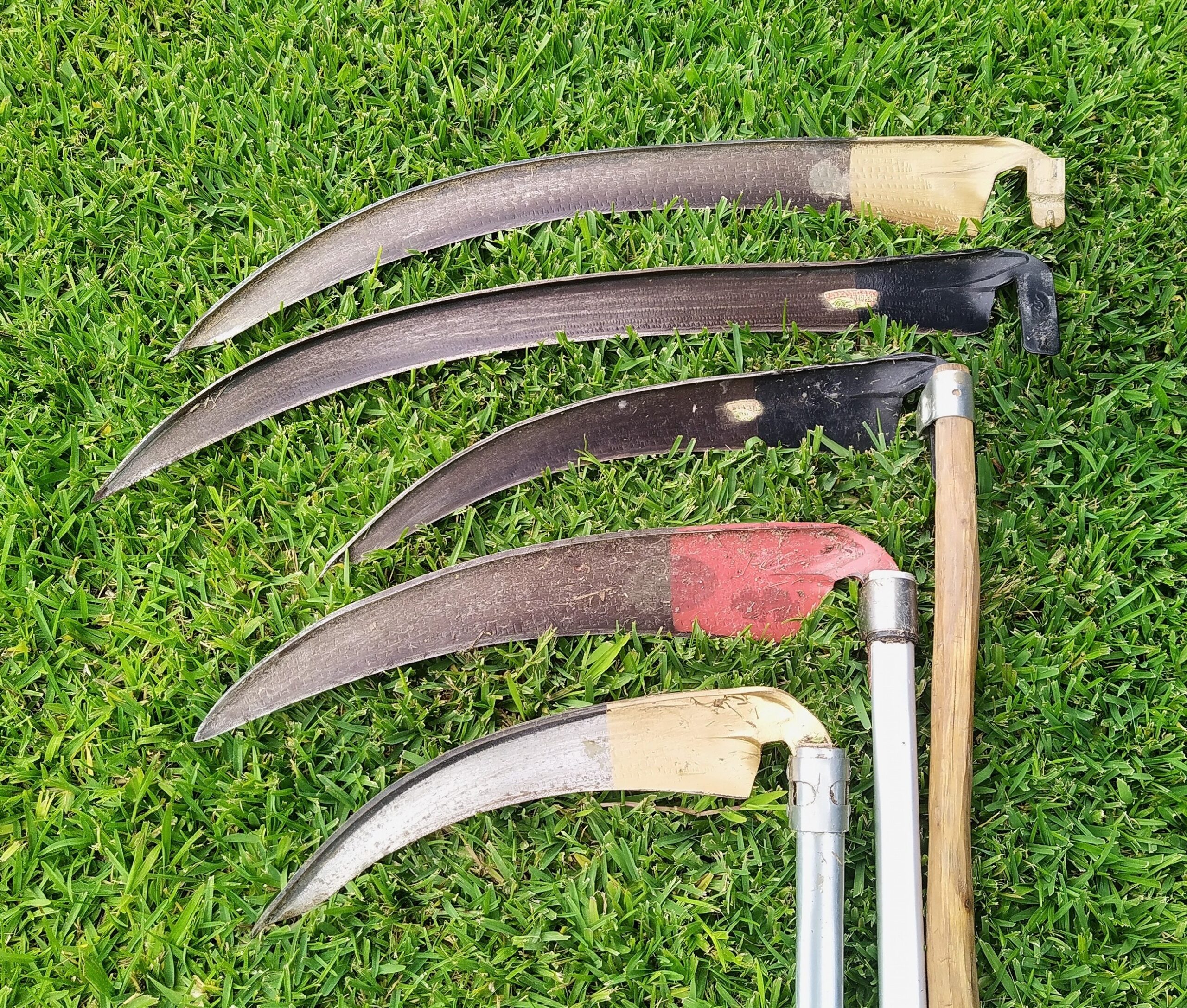
Scythe blades come in a variety of sizes and shapes, all suited to different functions. I have 75 cm, 50 cm and 40 cm blades, in differing weights. The tasks and technique of mowing differ for each blade.
75 cm scythe blades
These are the field mowing blades. They cut a good swathe of grass without picking up too much per swing, and allow a good rhythm. They’re also nimble enough to let you pitch them through the stroke to allow for uneven ground. I have a Falci blade and a Shroeckenfux blade, both are good, but quite different. The Falci blade is lighter and has a different angle to the snath, so that the blade edge sits higher off the ground. The Schroeckenfux blade is flatter heel to tip, and so I needed to put more curve in mine to stop it diving into the grass.
The 75 cm blades lend themselves to the classic scythe mowing style, using a full 180 degree swing with a good reach to the right, for which you need to have good leafy (not stemmy) grass so that you don’t get bogged down getting through your swathe, and have a reasonable amount of foliage to carry through the end of the stroke.
50 cm scythe blades
I also have one each 50 cm blade from Falci and Schroeckenfux, but these two are quite different. The Schroeckenfux is a heavy blade, suited to cutting heavy growth. I don’t keep this blade as sharp as a grass blade so it has a robust edge for mowing thick stems. The lighter blade I keep sharper for jobs like trimming grass from around plants. Some mowers sharpen blades for heavy work with only a file, but I still peen mine, and hone with a stone. Tall grass is immobile top (by inertia) and bottom, so the blade just needs to be sharp enough to cut easily, in contrast with a field blade that needs to be so sharp it cuts before the grass bends.
The 50 cm Falci blade is light, and good for scything tall but green stems off banks, where I can swing it like a pendulum. With 50 cm blades you’re cutting small arcs, a different technique to field mowing. We have pigeon grass here, which grows as a perennial clump of stems which can be over 2 m long, and it’s very heavy scything when fully grown, but with the 50 cm blades I can focus on a clump at a time.
I would rarely use the 50 cm blades with a field cutting style, as the 75 cm blades are more efficient for that. The 50 cm blades are nimble for working around orchard stems, hacking individual clumps of grass, or working where the ground changes contour.
40 cm scythe blades
40 cm blades are good for small spaces. I use mine for the vegetable garden paths and around trees, where longer blades can be awkward. This is work that I used to do with a hand sickle, which meant getting on my knees, so being able to stand to mow is a big improvement.